Estate Planning


Family matters carry a weight that few other legal problems do. A divorce, a custody dispute, or a question about support is never just paperwork. It touches your children, your home, your finances, and the version of your life that comes next. When you are standing in the middle of that, what you need is not a lecture. You need someone who understands both the law and what you are actually going through.
Vollrath Law has served families in Oviedo and across Seminole County for more than 25 years. Our attorneys handle divorce, child custody and time-sharing, child support, alimony, property division, and the modifications that come later when life changes again. We practice family law the way we would want it handled for our own families, with straight answers, steady guidance, and a plan you can actually follow.
Family law covers the legal relationships between spouses, parents, and children. A family law attorney helps you understand your rights, protects your interests during a stressful time, and handles the procedural work so that a single missed deadline or poorly worded agreement does not follow you for years. In Florida, almost every family law matter is governed by Chapter 61 of the Florida Statutes, and the details in that chapter decide real outcomes.
At Vollrath Law, our family law practice includes the following areas.
Not every situation needs a courtroom fight. Much of what we do is helping people reach fair agreements without one. When a case does need to be litigated, we are ready for that too.
Florida is a no-fault divorce state. You do not have to prove that your spouse did anything wrong. In most cases you only need to state that the marriage is irretrievably broken. Before you can file, one spouse must have lived in Florida for at least six months, a residency requirement set out in Fla. Stat. § 61.021. Divorce cases in Oviedo are filed in the Eighteenth Judicial Circuit, which serves Seminole County. You can read more about how we handle the full divorce process in Florida.
The single biggest factor in how long a divorce takes, and what it costs, is whether it is uncontested or contested.
An uncontested divorce means you and your spouse agree on every issue, including how to divide property and debt, custody and time-sharing, child support, and alimony. These cases move faster and cost far less. Even when you agree, having an attorney review the marital settlement agreement matters, because once a judgment is entered it is very difficult to reopen.
A contested divorce means there is at least one issue you cannot resolve on your own. The court steps in through a process of disclosures, negotiation, mediation, and, if needed, trial. Most Florida courts require couples to attempt mediation before a judge will hear the case.
Florida offers a faster track called simplified dissolution of marriage under Fla. Stat. § 61.052. It is available only to couples who meet every one of these conditions.
For couples who qualify, a simplified dissolution can be finalized in a matter of weeks rather than months. The tradeoff is that both spouses give up certain rights, including the right to a trial and, in most cases, the ability to seek support later. That is why it is worth confirming you truly qualify before filing. We cover this in more detail in our guide on how to get a divorce immediately in Florida.
While every case is different, a typical Florida divorce follows this path.
An uncontested divorce in Seminole County can sometimes wrap up in a month or two once everything is agreed and filed. A contested divorce often takes several months to a year or more, depending on the issues and the court calendar. Cost follows the same pattern. The more you and your spouse can agree on, the less you spend. Fighting over every item can cost more than the items are worth, which is why we push hard for fair, durable agreements wherever they are possible.
Florida is an equitable distribution state, governed by Fla. Stat. § 61.075. Equitable means fair, which is not always the same as equal. The court starts from the premise that marital assets and debts should be divided evenly, then adjusts if an even split would be unfair given the circumstances.
Before anything is divided, each asset and debt is sorted into one of two categories.
The line blurs when non-marital property is mixed with marital property. If you inherit money and deposit it into a joint account, that commingling can turn it into a marital asset, a question we cover in depth in our guide on when an inheritance becomes marital property. These distinctions decide who keeps what, so they are worth getting right.
When an even split would not be fair, Fla. Stat. § 61.075(1) lets the court consider factors such as the length of the marriage, each spouse’s economic circumstances and contribution to the marriage (including as a homemaker or caregiver), interruptions to one spouse’s career or education, the desirability of keeping an asset like a business or the family home intact, and whether either spouse intentionally wasted or hid marital assets.
The marital home is often the hardest asset to divide. When children are involved, the court may award temporary use of the home to the parent with the majority of time-sharing, even if the home is eventually sold. Retirement accounts usually require a special order called a Qualified Domestic Relations Order, or QDRO, to divide the portion earned during the marriage without triggering taxes and penalties. A family business needs a proper valuation, and options range from one spouse buying out the other to selling and splitting the proceeds. If you are weighing whether to sell real estate as part of the split, our team can coordinate with the firm’s real estate practice so it is handled cleanly.
Florida overhauled its alimony law in the 2023 alimony reform. Permanent alimony no longer exists in the state. Under the current version of Fla. Stat. § 61.08, a court first decides whether one spouse has an actual need for support and whether the other has the ability to pay. Only if both are true does the court move on to the type, amount, and length of any award.
The 2023 reform tied alimony to the length of the marriage, which the statute now defines as short-term (less than 10 years), moderate-term (10 to 20 years), and long-term (20 years or more). Durational alimony generally cannot exceed 50 percent of the length of a short-term marriage, 60 percent of a moderate-term marriage, or 75 percent of a long-term marriage. On amount, durational alimony is capped at the recipient’s reasonable need or 35 percent of the difference between the spouses’ net incomes, whichever is less. These are ceilings, not guarantees, and how your facts fit the statute makes a real difference.
Florida law does not use the word custody the way many people expect. Instead, it focuses on parental responsibility (who makes major decisions for the child) and time-sharing (the schedule of when the child is with each parent). Both are governed by Fla. Stat. § 61.13, and our Oviedo child custody attorneys handle both sides of these cases.
Since 2023, Florida law includes a rebuttable presumption that equal time-sharing is in the best interest of the child. In plain terms, the court starts from the position that a 50/50 schedule is best. A parent who believes an equal split would not serve the child must show that with the greater weight of the evidence. This was a meaningful shift, and it changes how these cases are argued.
Florida requires a parenting plan in every case involving minor children. A parenting plan spells out the details so there is less to fight about later, including the following.
When parents cannot agree, the court decides time-sharing based on a list of best-interest factors in Fla. Stat. § 61.13(3). These include each parent’s ability to support a relationship with the other parent, the stability of each home, the moral fitness and physical and mental health of each parent, the child’s school and community record, the reasonable preference of the child if mature enough, each parent’s history of involvement in the child’s life, and any evidence of domestic violence or substance abuse. For a deeper walkthrough, see our overview of Florida custody laws. The court weighs the whole picture, not any single factor.
Child support in Florida is not guesswork. It is calculated under statutory guidelines in Fla. Stat. § 61.30 using an income shares model, which estimates what the parents would have spent on the child if the family had stayed together and divides that responsibility between them. Our Oviedo child support attorneys handle establishing, calculating, and enforcing support.
The guideline calculation is driven by a defined set of inputs.
Because overnights feed directly into the number, time-sharing and child support are linked. A change to one can change the other. Courts can deviate from the guideline amount in specific situations, but they must explain why.
Child support is not frozen forever. If there is a substantial, permanent, and involuntary change in circumstances, such as a job loss, a significant income change, or a change in the parenting schedule, either parent can ask the court to modify the amount. The change is not automatic, and it generally applies from the date you file, so acting promptly matters.
Life keeps moving after a divorce is final. People change jobs, remarry, relocate, and grow. Florida law allows time-sharing, child support, and some alimony awards to be modified when there is a substantial change in circumstances that was not contemplated at the time of the original order. On the other side, if a former spouse or co-parent is ignoring a court order, whether by withholding support or refusing to follow the parenting plan, the court has tools to enforce it, including contempt proceedings. We handle both, whether you need to update an order or hold someone to one.
A well-drafted prenuptial or postnuptial agreement before or during a marriage can protect assets, define expectations, and spare both spouses an expensive dispute later. These agreements have to be prepared carefully to hold up, and we draft and review them so they do.
Establishing paternity gives a child the right to support and gives a father the right to time-sharing and a role in decisions. It can be a straightforward process or a contested one, and it is the foundation for support and custody rights when parents are not married.
Florida has specific rules when a parent wants to move more than 50 miles away with a child. Relocation requires either the other parent’s written agreement or the court’s permission, and doing it the wrong way can seriously damage a parent’s case. We handle both sides of relocation disputes.
For couples who want to avoid a courtroom, collaborative divorce is a structured process where both spouses and their attorneys commit to reaching an agreement out of court, often with the help of neutral financial and mental health professionals. It can be less adversarial, more private, and easier on children.
When safety is at risk, Florida law allows a person to petition for an injunction for protection, often called a restraining order. These matters move quickly and can affect time-sharing, use of the home, and more. Whether you need protection or you are responding to a petition, the stakes are high and the deadlines are short, so it is important to have someone in your corner right away.
You have options when it comes to a family law attorney, so here is what sets our firm apart.
Clients regularly tell us the same thing, that we made a hard time feel manageable and that we were responsive when it mattered. That is the standard we hold ourselves to.
We keep the path forward simple and predictable.
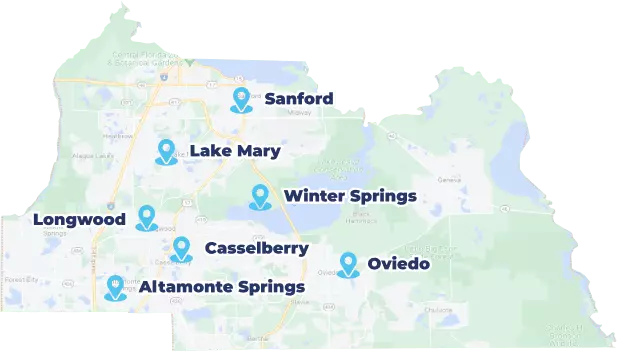
Our office is located at 1757 W. Broadway, Suite 3, Oviedo, FL 32765. We represent families throughout Central Florida, including Oviedo, Winter Springs, Casselberry, Sanford, Lake Mary, Longwood, Geneva, and the surrounding Seminole County communities. If you are searching for a family law attorney near you in this area, we would be glad to help.
How is child support calculated in Florida?
Florida uses an income shares model under Fla. Stat. § 61.30. The calculation combines both parents’ net incomes, the number of overnights each parent has with the child, health insurance and child care costs, and certain other expenses. Because overnights affect the amount, the parenting schedule and child support are connected.
Is Florida a 50/50 custody state?
Since 2023, Florida law includes a rebuttable presumption that equal time-sharing is in the best interest of the child. That means the court starts from a 50/50 schedule, and a parent who wants a different arrangement must show why an equal split would not serve the child.
How long does a divorce take in Florida?
An uncontested divorce can sometimes be finalized in a month or two once everything is agreed and filed. A contested divorce usually takes several months to a year or more, depending on the issues involved and the court’s schedule.
How much does a divorce cost in Florida?
Cost depends almost entirely on how much you and your spouse disagree. An uncontested or simplified divorce is far less expensive than a contested one that requires extensive discovery, expert valuations, and trial. Reaching agreements wherever possible is the most reliable way to control cost.
Do I still need a lawyer for an uncontested divorce?
You are not required to have one, but it is wise. Once a final judgment is entered it is very hard to change. An attorney makes sure your settlement agreement is fair, complete, and enforceable, so a small oversight today does not become a serious problem later.
How is property divided in a Florida divorce?
Florida follows equitable distribution under Fla. Stat. § 61.075. Marital assets and debts are divided fairly, starting from an even split and adjusting when the circumstances make an even split unfair. Non-marital property, such as assets owned before the marriage or certain inheritances, generally stays with its original owner. Our guide on splitting assets in a divorce covers this in more detail.
Does Florida still have permanent alimony?
No. Florida eliminated permanent alimony in its 2023 reform. The current types are temporary, bridge-the-gap, rehabilitative, and durational alimony, each with its own limits on length and amount under Fla. Stat. § 61.08.
Can I modify child support or a parenting plan later?
Yes, if there is a substantial, permanent, and involuntary change in circumstances, such as a significant income change or a change in the parenting schedule. Modifications are not automatic, so you have to petition the court, and changes generally apply from the date you file.
Whatever you are facing, you do not have to figure it out alone. The sooner you understand your options, the better your decisions will be. Call Vollrath Law or reach out through our contact page for a free consultation, and let us help you move forward with confidence.
This page is for general information only and is not legal advice. Family law outcomes depend on the specific facts of your case and on current Florida law. For advice about your situation, speak with a licensed Florida attorney.
Had the opportunity to utilize this office for estate planning: Last Will and Testament, Power of Attorney, Designation of Health Care Surrogate, and Living Will. We had the pleasure of working with Brian Buck and Melora Vandersluis Esq. The process was very smooth and we utilized a secure portal to review documents and to prepare for questions …

Our experience with Vollrath Law was excellent. We had an initial phone consultation for our will and potential trust, then worked with one of the associates by email until we scheduled our signing appointment. Everyone in the office is friendly and professional and answered all of our questions/ concerns …

Sharon, Stephanie and Amanda are the dream team with title closings for my customers and for me personally. Highly recommend for stress free, efficient and fast mortgage closings for new purchases and refinances in the state of Florida.

We can’t wait to help you tackle your legal challenges and achieve your goals! Our first step is to chat with you and really get to know your unique situation. We’ll listen to your concerns, answer any questions you may have, and create a customized legal strategy that meets your needs and goals.
With our strategy in place, we’ll work with you to bring your legal matter to a successful resolution. No matter what legal challenge your family is facing, we’re here to guide you every step of the way.
We understand that legal paperwork can be overwhelming, but we’ll make it easy and stress-free for you. We’ll help you prepare and file any necessary documents, ensuring that everything is accurate and up-to-date.
In some cases, negotiations and mediation can help resolve legal matters without going to court. We’ll work with you to find common ground and reach a resolution that meets your needs and goals.
Our final step is to help you achieve success and move forward with confidence. Whether it’s a finalized estate plan that provides peace of mind, or a successful divorce settlement that protects your interests, we’re dedicated to helping you achieve your goals and thrive in the future.
Child support in Florida is calculated based on the Income Shares Model. This model considers parents’ incomes and the child’s time with each parent. Other factors, such as health insurance and childcare costs, may also be considered.
When choosing a family law attorney, it’s important to look for someone who has experience handling similar cases, is knowledgeable about Florida family law, and is responsive to your needs. You should also consider the attorney’s communication style, availability, and fees.
The legal process for divorce in Florida involves:
The case will go to trial if a settlement cannot be reached. The court will then issue a final judgment on the dissolution of the marriage.
Child custody in Florida is determined based on the best interest of the child standard. The court will consider factors such as the child’s relationship with each parent, the child’s needs and preferences, and each parent’s ability to provide for the child’s needs.